What it is and how to optimise content for AI search

Generative Engine Optimisation (GEO)
Generative Engine Optimisation (GEO): What It Is and How to Optimise Content for AI Search
(Audit your site now by clicking here)
Starting a website used to be relatively straightforward.
You’d write something, optimise it for Google, maybe obsess over a keyword or two, and hope it ranked.
That was the whole game.
Now there’s… something else.
Not instead of search, but sitting quietly on top of it.
AI answers.
Ask a question in ChatGPT, Perplexity, or Google Gemini and you don’t get ten blue links. You get a response. A summary. A stitched-together answer pulled from somewhere (and sometimes nowhere obvious at all).
Which raises a slightly uncomfortable question:
Why does some content get cited in AI answers… and most of it doesn’t?
What is Generative Engine Optimisation (GEO)?
Generative Engine Optimisation (GEO) is the process of optimising content so it can be understood, extracted, and reused by AI systems like ChatGPT, Perplexity, and Gemini.
Not just ranked.
Used.
It’s less about “where you appear” and more about:
👉 whether your content becomes part of the answer
SEO vs GEO (and why they’re not the same thing)
Traditional SEO focuses on:
-
rankings
-
keywords
-
backlinks
-
traffic
GEO focuses on something slightly different:
-
clarity
-
structure
-
extractability
-
usefulness in isolation
Search engines point people to your content.
AI systems take pieces of your content and bring them into the answer.
Subtle difference. Big implications.

How AI search actually chooses content
We don’t get a neat rulebook here (annoying, I know).
But patterns are starting to emerge.
Content that gets cited in AI answers tends to be:
-
clear and direct
-
structured logically
-
written in a way that answers real questions
-
easy to quote or summarise
-
specific, not vague
In other words:
👉 content that’s easy for a human to understand quickly
👉 is also easy for an AI to reuse
Why most content isn’t optimised for AI search
Because it was never meant to be.
A lot of content today is still built around:
-
“make it longer”
-
“add more keywords”
-
“sound authoritative”
Which often results in:
-
buried answers
-
vague statements
-
long introductions that go nowhere
-
structure that looks good but says very little
It might rank.
But it’s not particularly usable.
And AI systems are optimised for usability.
How to optimise content for AI search (GEO basics)
If you want your content to show up in AI-generated answers, start here:
1. Answer the question immediately
Don’t build up to it.
Say the thing.
Then expand.
2. Use clear, structured formatting
-
headings that match real questions
-
bullet points where helpful
-
defined sections
This helps both readers and AI systems navigate your content.
3. Make content easy to extract
Ask yourself:
Could someone copy and paste this into an answer without rewriting it?
If not, it’s probably too vague or too messy.
4. Include specific, concrete details
AI systems favour:
-
named tools
-
real examples
-
specific data points
Not: “many experts believe…”
5. Cover the topic properly (not just broadly)
Topical authority in GEO isn’t about word count.
It’s about:
👉 actually answering the question fully
A shorter, complete answer will outperform a long, unfocused one.

A quick reality check
Most content doesn’t do this.
Even content that ranks well in Google often scores poorly when you look at it through a GEO lens.
Not because it’s bad.
Just because it’s optimised for a different system.
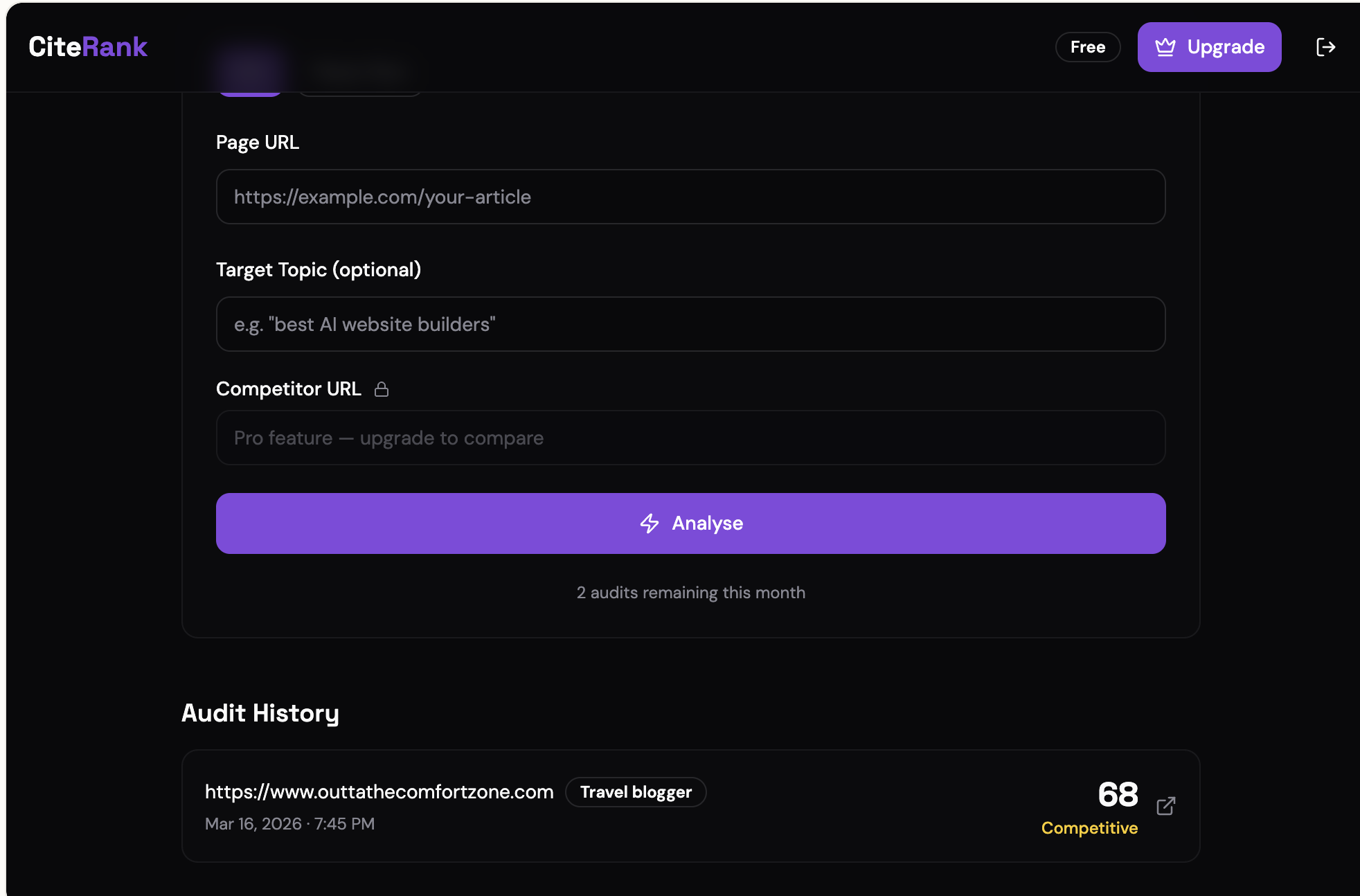
I built a tool to test this
Partly out of curiosity, partly because I couldn’t stop thinking about it.
It analyses content and scores how likely it is to be cited by AI systems based on things like:
-
entity coverage
-
conversational query alignment
-
extractability
-
structure
-
source credibility
It’s not claiming to predict AI behaviour perfectly (no one can).
But it gives you a very clear signal:
👉 is this content actually usable by AI?
What this means going forward
SEO isn’t going anywhere.
But it’s no longer the full picture.
Content now needs to work in two environments:
1. Search engines
2. AI-generated answers
And the overlap is smaller than people expect.
If you’re creating content right now
Start asking:
-
Does this answer the question clearly?
-
Could this be quoted directly?
-
Is this structured in a way that’s easy to follow?
If not, it might still rank.
But it probably won’t be cited.
Try it yourself
If you’re curious how your content performs, you can run a GEO audit and see where it stands.
No magic fixes.
Just a clearer view of how content works now.